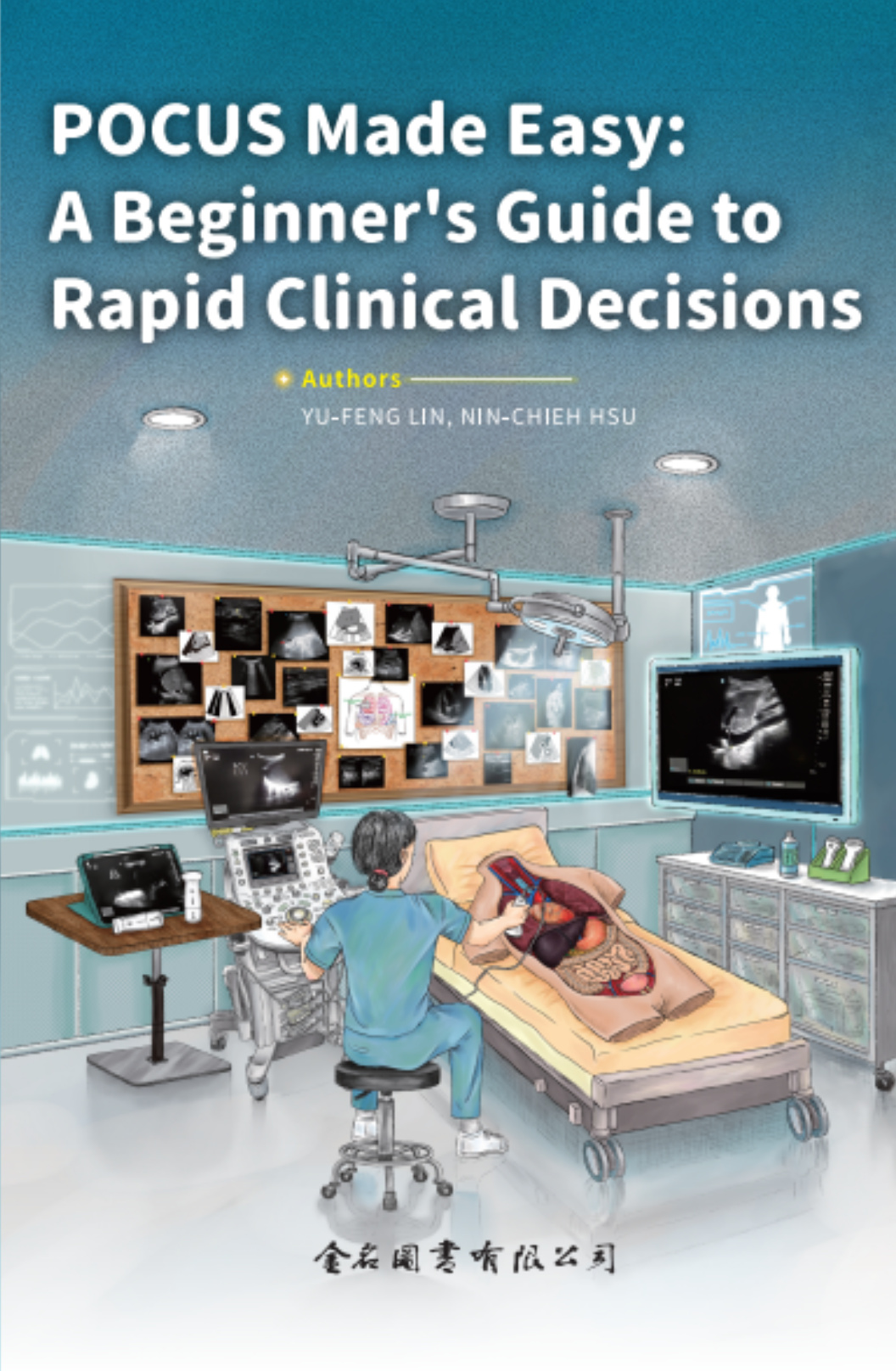
POCUS Made Easy A Beginner's Guide to Rapid Clinical Decisions
Highlight 1: Leave abstraction behind—learn visually, until it clicks
Traditional ultrasound texts often read as though they were written for readers who already know the subject. Beginners are left unable to connect the anatomical section shown on the screen with the surface anatomy where the probe is placed to obtain it.
To close this gap, we made bold choices in layout and illustration:
• Real-life photography. Every scanning technique is photographed on a live model, showing exactly where the probe is placed and how it is angled. Nothing is left to the imagination.
• Carefully redrawn schematics. Real ultrasound images are translated into intuitive anatomical sketches and see-through diagrams. Overlays and highlighted landmarks help your brain build a three-dimensional sense of space quickly, so that understanding becomes intuitive rather than laborious.
Highlight 2: Pocket cards and mnemonics that come to the rescue
At the bedside, where every second counts, what you need is not a lengthy discussion but an intuitive reflex.
• Differential-diagnosis flowchart cards. Specially designed pocket cards at the end of the book weave POCUS into the decision-making process of differential diagnosis. We strongly recommend carrying them on every shift, ready to be pulled out whenever a challenge arises.
• Powerful mnemonics. Easy-to-remember mnemonics are woven throughout the text (for example, FLAT for inferior vena cava assessment) so that even under pressure you can complete a standardized examination in an orderly way.
Highlight 3: The eight-step framework—building clear clinical reasoning
Knowing the moves of a martial art is useless if you do not know when to strike, in what order, and what to do next. Understanding how POCUS connects to the surrounding clinical workflow is as important as knowing how to scan.
Every chapter unfolds according to the same carefully designed set of eight core modules. We recommend reading in this order, because it mirrors the standard reasoning we use to solve problems at the bedside:
1. Role and importance of POCUS. First understand why the examination is done, and establish its core value and place in clinical practice.
2. When to perform POCUS. Learn when to do it: the symptoms and signs that should prompt you to bring the ultrasound machine to the bedside immediately.
3. Decision flowchart. Complex reasoning distilled into a decision tree you can take in at a glance. Follow the arrows and your thinking will not get tangled.
4. Scanning technique. Hands-on instruction covering patient preparation, probe selection, machine settings, and precise scanning steps, all in one place.
5. Image interpretation. Learn to read the screen. Normal and abnormal reference values and criteria are provided so that the physiological meaning behind each image can be interpreted accurately.
6. Clinical management. The most down-to-earth section of the book. We teach not only how to scan but what to do once the scan is done. Clinical scenarios are included so that what you have just learned can be applied immediately in practice.
7. Common pitfalls and errors. You need not fall into the traps others have already discovered. The mistakes and image blind spots most common among beginners are pinpointed precisely.
8. Summary. The essence of the chapter distilled into a few concise sentences to reinforce memory.
Highlight 4: Chapters built as modules, so you can trust your own findings
Traditional POCUS texts are organized by organ or system. What clinicians need, however, is not a broad but shallow survey; it is confidence in their own assessment.
• Inferior vena cava diameter. Obtain a measurement you can trust, and map it accurately to the patient's volume status.
• Pulmonary edema. When the chest radiograph is equivocal, let POCUS give you confidence.
• Bladder. Learn to read the shape and calculate a volume that comes closest to the actual catheterized amount.
Solid, self-contained modules are exactly what you need as you begin.
Medical knowledge is vast, but clinical decisions must often be made in an instant. We hope POCUS Made Easy: A Beginner's Guide to Rapid Clinical Decisions becomes the most reassuring support at your bedside. Do not be afraid to wear this book out—every reading is a solid step toward becoming a POCUS expert.
Now pick up your probe, and let us begin this remarkable journey together.